Your Documentary Isn’t 1 Story. It’s 90.
Most filmmakers are taught to think about story at the level of the entire film. What’s the beginning? What’s the middle? What’s the ending? What does the character want, and where do they change? All of that matters, but when you’re actually standing in the field trying to figure out what to shoot next—or staring at 80 hours of footage in an edit bay—it can feel almost uselessly big.
Because sitting inside your documentary right now, there probably isn’t one story. There are dozens of them. In a feature documentary, there may be something closer to 90 little stories linked together to create the larger one. Once you learn to recognize those smaller stories, you get much more efficient in the field and you can get to a viable rough cut significantly faster.
I use a framework for this that I call Nested Arcs.
Watch my Youtube video about it.
How I Started Seeing Stories Differently
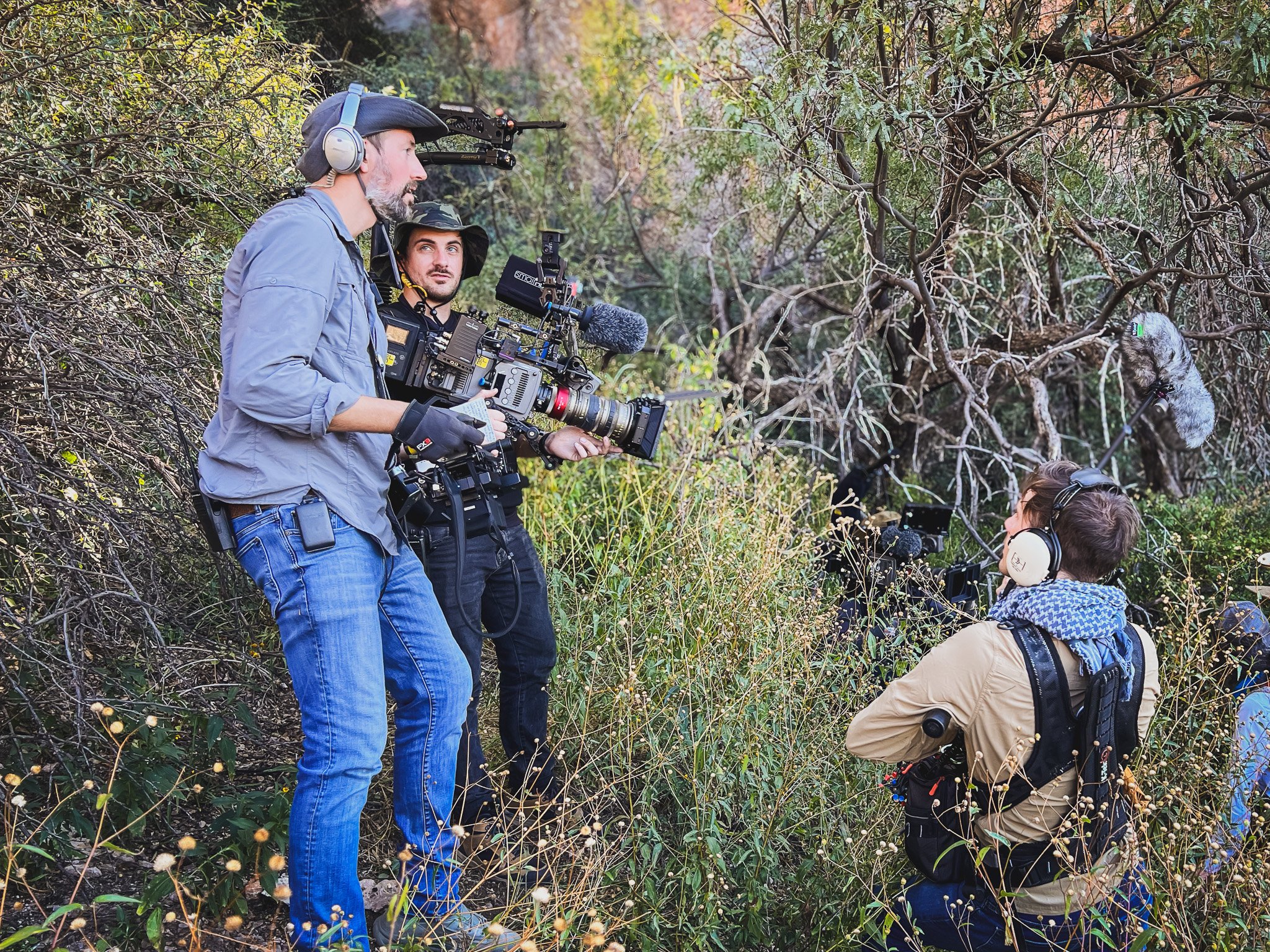
I developed Nested Arcs while directing a lot of documentary television for PBS. My team and I were constantly finding stories, shooting hours of footage, and turning all of that material into episodes under very tight deadlines. When you do that enough, patterns start to emerge.
It reminds me of looking at a pond. At first, you just see the surface. Then you put on polarized sunglasses and suddenly you can see all these fish swimming underneath. That’s what started happening to me with story. I stopped seeing only the big narrative and started seeing all the smaller stories happening beneath it.
Those smaller stories became a practical way for me to understand what to shoot, how to organize footage, and where an edit was working—or wasn’t.
What Is a Nested Arc?
Think of Russian nesting dolls. The film contains acts. Acts contain sequences, which are basically chapters. Those sequences contain scenes, often around a minute long. Each of those levels can function as its own story.
The Nested Arcs framework: a documentary is made of complete stories nested inside larger stories—from individual scenes and sequences to acts and the entire film.
That’s the basic idea behind Nested Arcs. An act can have a setup, pressure, and result. A sequence can have a setup, pressure, and result. An individual scene can too.
The basic framework is:
Setup → Pressure → Result
Setup establishes the situation. Pressure introduces uncertainty, resistance, conflict, or change. The result gives us some kind of outcome. The magic is in how those little stories connect, because the result of one scene often becomes the setup of the next. Then that result creates another setup, and the story keeps moving forward until the larger arc is complete.
How Pamela, A Love Story Does It
One of the clearest examples I’ve found is the Netflix documentary Pamela, A Love Story. I broke down the first act of the film, which runs about 23 minutes, and inside those 23 minutes I counted 21 distinct scenes or small story units. That’s 21 little stories inside one act.
You don’t consciously notice that structure while you’re watching. You just feel movement. One thing leads naturally to another, and before you know it, you’ve traveled a long way through Pamela’s life without ever feeling like the filmmakers stopped to explain the structure to you.
There’s a scene roughly 13 minutes into the film that lasts about a minute. Pamela is telling a story in an interview about going to a football game when she was younger. The setup is simple: Pamela goes to the game with some friends.
Then comes the pressure. She suddenly appears on the Jumbotron. The crowd reacts, and the people running the event ask her to come onto the field. Something unexpected has happened, and now we want to know where it’s going.
The result is that a beer company notices how photogenic she is and offers her a job in a commercial. That’s a complete story in roughly a minute: setup, pressure, result.
But the more important part is what happens next. The result of that scene becomes the setup of the following one. Now Pamela is appearing in the beer commercial, which becomes our new setup.
The commercial gets noticed by Playboy. They call her. She isn’t even sure the call is real, and she’s scared about what it could mean. That becomes the pressure. Eventually, she takes the chance and flies to Los Angeles, which becomes the result.
And now that result becomes the setup for another story. This happens over and over throughout the film. You answer one question and almost immediately create another, which is where so much of the momentum comes from. What looks from the outside like one giant 90-minute story is actually dozens and dozens of smaller stories chained together.
That’s Nested Arcs.
How Nested Arcs Can Speed Up Your Edit
This is where the framework becomes less of a storytelling theory and more of a practical workflow. Trying to solve an entire feature documentary on one timeline is mentally exhausting because you’re asking your brain to hold too much information at once.
Instead, start by identifying the major sequences in the film—the chapters. In Pamela, A Love Story, for example, you could describe an early sequence as Pamela’s childhood trauma. That section lasts roughly 12 minutes.
If you were editing that film, you could create a dedicated timeline for that sequence and start moving all of the relevant interview material, vérité, archival footage, and other moments dealing with her early childhood into that timeline. Then start identifying the smaller stories inside it.
Where is there a complete little arc? Where is the setup? Where does pressure enter? What is the result? Edit those into small scenes and leave gaps between them. At this stage, don’t worry about polish. This is an assembly.
You’re identifying, trimming, and organizing the strongest small story units you actually have. That alone can solve a huge part of the editorial problem because instead of asking yourself, “How do I make this entire movie work?” you’re asking, “How do I make this one small story work?”
Eventually, you might end up with eight, ten, or twelve strong sequences, each on its own timeline. From there, you can organize those sequences into larger act timelines if that helps you see the bigger picture. Eventually, when the structure is working, you can bring everything together for the final film.
You’re solving the movie from the inside out.
But Doesn’t This Make Everything Formulaic?
This is usually where someone tells me this sounds way too templated, and I agree—with one important distinction. Nested Arcs are not how you make a great film. They’re a way to get to the starting point of a great film faster.
A clean linear structure gives you something solid enough to begin experimenting with. Once you have that foundation, that’s when the interesting work begins. You can rearrange scenes, move sequences, open with something from much later in the story, delay the result of an arc to create suspense, intercut two completely different stories, or let one question hang unresolved while you move somewhere else.
That’s where structure starts turning into art. The framework is scaffolding. It isn’t the building.
A journalist I greatly admire used to say that you should start with the linear order of the story so you have a solid foundation before you start playing with order and flow. I’ve found that advice incredibly useful. You need something coherent before you can intentionally break it.
Nested Arcs Work in the Field Too
This way of thinking isn’t just useful for editors. It changes the way you shoot because you start looking for the little story unfolding directly in front of you instead of simply collecting coverage.
Maybe someone is trying to accomplish something. Maybe there’s an argument beginning. Maybe a plan is falling apart. Maybe a character encounters resistance they weren’t expecting. Once I recognize that pressure, I know there may be an arc happening.
One of the biggest mistakes you can make at that point is leaving before you get the result. What happens? Does the problem get solved? Does the person fail? Does somebody change their mind? Does the argument resolve? Does the situation become even worse?
Even in interviews, I’m looking for that movement. Give me the setup. What was happening before? Where did the pressure enter? What did you do? What happened because of it? You start collecting stories instead of simply collecting information.
A Useful Way to Diagnose a Dead Scene
Nested Arcs can also help when you’re watching a rough cut and something simply feels off. Maybe the scene is beautifully shot. Maybe the interview is strong. Maybe the information matters. But it still feels dead.
Look for the movement. Is there new pressure? Is there uncertainty? Is something being revealed? Does anything meaningfully change? If not, that might explain why the scene is stalling.
You don’t automatically have to cut it. Maybe the setup needs to be shorter. Maybe you’re missing the result. Maybe the pressure exists elsewhere in the footage, or maybe the scene belongs inside another sequence. The framework doesn’t tell you what the artistic answer is—it tells you where to start looking for the problem.
The Small Story Has to Feed the Big One
There’s one important warning here. You can’t just string together a hundred random little stories and expect them to become a great documentary. The best nested arcs reveal something about the larger film.
Pamela going to the football game matters because it changes the trajectory of her life. The beer commercial matters because it leads to Playboy, and Playboy takes her somewhere else. Each small story pushes the larger story forward.
That’s the filter. A scene can be entertaining and still not belong in the movie. Whenever you find a good little arc, ask one more question: What larger story is this little story feeding?
If you can answer that, there’s a good chance you have something useful.
Shrink the Problem
If you’re stuck on a documentary right now, resist the urge to immediately tear apart the entire film. Shrink the problem. Take one scene and ask what the setup is, where the pressure enters, and what the result is.
Then ask what larger story that scene is serving. If you can answer those questions, you probably have a functioning story unit. If you can’t, you’ve learned something important about why the scene may not be working.
Story doesn’t only happen at the level of the movie. It happens all the way down.
If you’re working through a documentary, treatment, paper edit, rough cut, or story structure and want another set of eyes on it, I also offer one-on-one filmmaking and story consulting. You can learn more about working with me through my website.